


Basic Concept:-
Compound Interest(CI):- In a situation,
where the interest due at the end of a certain period is added to the
principal, and then both the principal and interest earn interest for the next
period, the interest paid is called Compound
Interest.
Basically it is the addition of interest to the principal sum of a
loan or deposit.
Formula:- a) When the interest is
compounded yearly:
A = P{1 + (r /
100)}n
where
A = Total amount after n years.
P = Principal
(Initial value)
r = Rate of
compound interest
n = number of
years
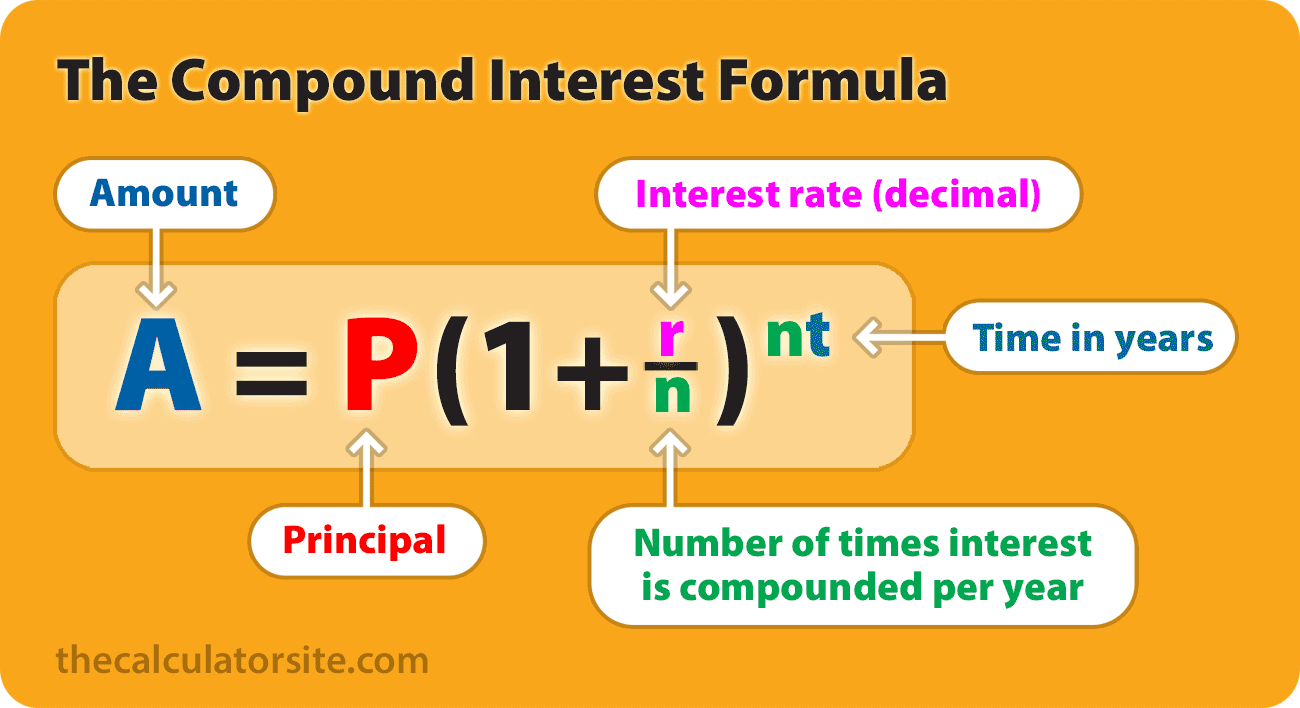
b) When the interest is compounded for a
certain numbers of times per year:
Ex 1. Find the amount and compound interest of
rs. 30000 invested for 3 years at a rate of 9% compounded yearly.
Ans.
P = Rs. 30000
r = 9%
n = 3 years
Amount = P{1 + (r / 100)}n
= 30000{ 1 + (9 / 100)}3
= 30000( 109
/ 100)3
= Rs. 38850.87
The required
compound interest = Amount – Principal = (38850.87 – 30000) = Rs.
8850.87
Ex 2.:- A businessman borrowed rs. 100000 for 9
months at 8% compound interest per annum. If the interest is compounded
quarterly, then what is the amount of money he will have to pay at the end of 9
months?
Ans.
P = Rs. 100000
r = 8% = .08
t = (9 / 12) years = 3 / 4 years
n = (12 / 3) = 4 times
Amount = P{1 + (r / n)}nt
= P{1 + (r / n)}4 × ¾
= 100000{1 + (.08 /
4)} 4 × ¾
= Rs. 106120.80
Tips Relating Problems on Compound
Interest:-

1.
If
an amount of money becomes x times of itself in n years, then rate of compound
interest = 100[(x)1/n-1].
Ex. If a
sum becomes 27 times in 3 years then what will be the rate of compound
interest?
Ans. R =
[100(27)1/3-1]% = 200%
2.
A
sum of money becomes rs. x in n years and rs. y in (n + 1) years at
a rate of interest compounded yearly.
Then the Principal = x(x / y)n.
Ex. An amount of money invested at
compound interest becomes rs.529 in 2 years and rs. 575 in 3 years. What is the
Principal?
Ans. P = 529(529 / 575)2 =Rs.
447.75
3.
At
compound interest a sum of money becomes x times in ‘a’ years and y times in
‘b’ years. The two sums can be related by the formula: (x)1/a = (y)1/b
Ex. At compound interest a sum of money
becomes thrice in 6 years. In how many years will it amount to 27 times itself?
Ans. Let the money will amount to 27 times
itself in t years.
(3)1/6 = (27)1/t
or, 1 / 6 = 3 / t
or, t
= 18 years
4.
If
the compound interest of an amount of sum for n years is rs. x and simple
interest per annum = [n(x – y) × 100 / y].
Ex. If the compound interest on a certain
sum for 2 years is rs. 80 and simple interest for 2 years is rs. 50, then what is the rate of interest?
Ans. R = [2(80 – 50) × 100 / 50] = 120%
5.
If
a sum of money grows upto rs.a in n years and upto rs. b in (n + 1) years on
compound interest, then Rate of interest = [(b – a) × 100 / a].
Ex. If a sum of money grows upto rs. 5000
in 4 years and upto rs. 5500 in 5 years on compound interest. What will be the
rate of compound interest?
Ans. R = [(5500 – 5000) × 100 / 5000]%
= [500 × 100 / 5000]%
= 10%
Few examples have been given on the basic problems
of ‘compound interest’ in the video below.
In the following video some examples have been given on the advance problems on 'Compound Interest'.
3 Comments
Khub bhalo initiative
ReplyDeleteThanks.
DeleteWell done... 👌👌👌👍👍👍
ReplyDelete